

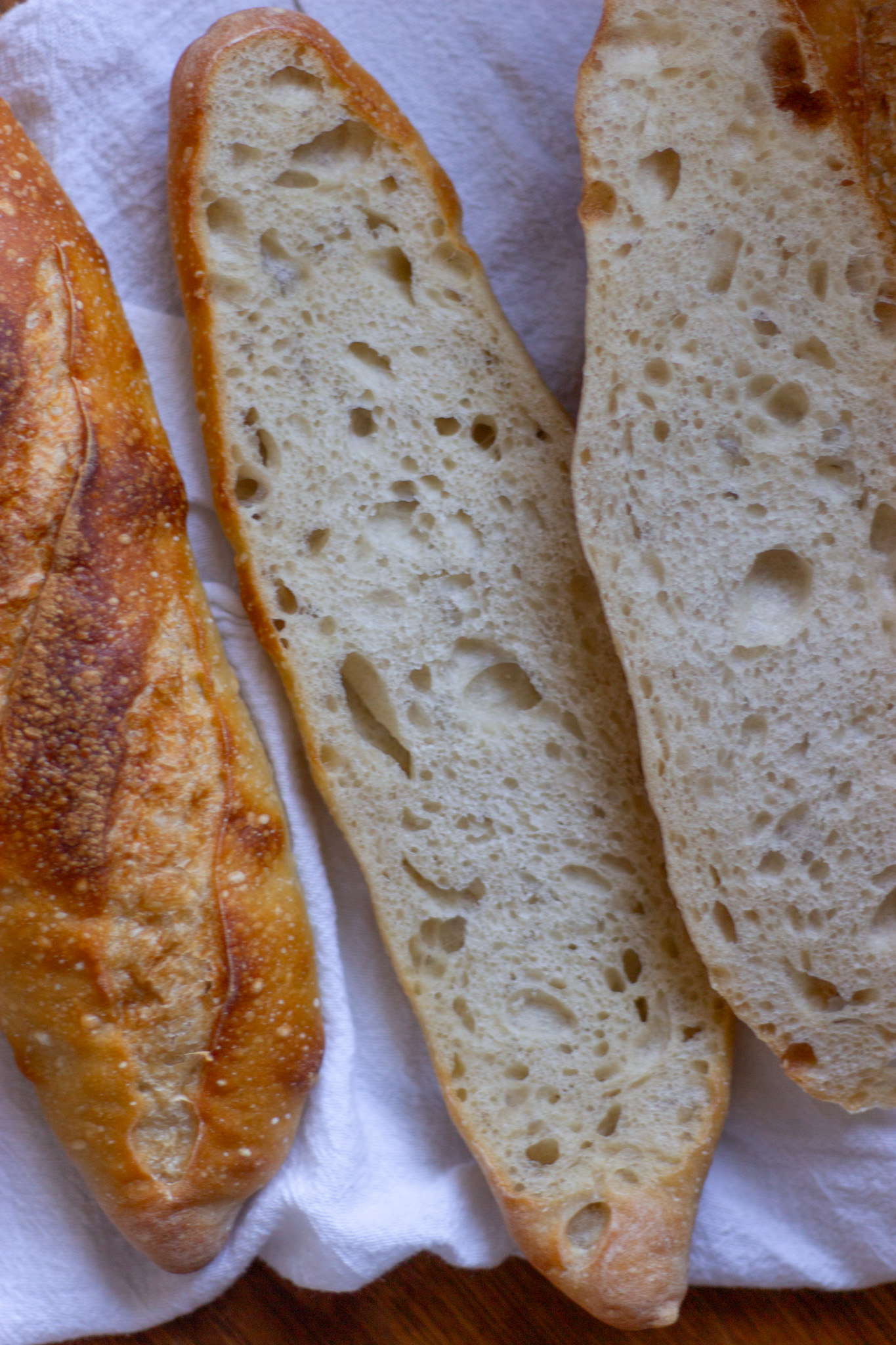
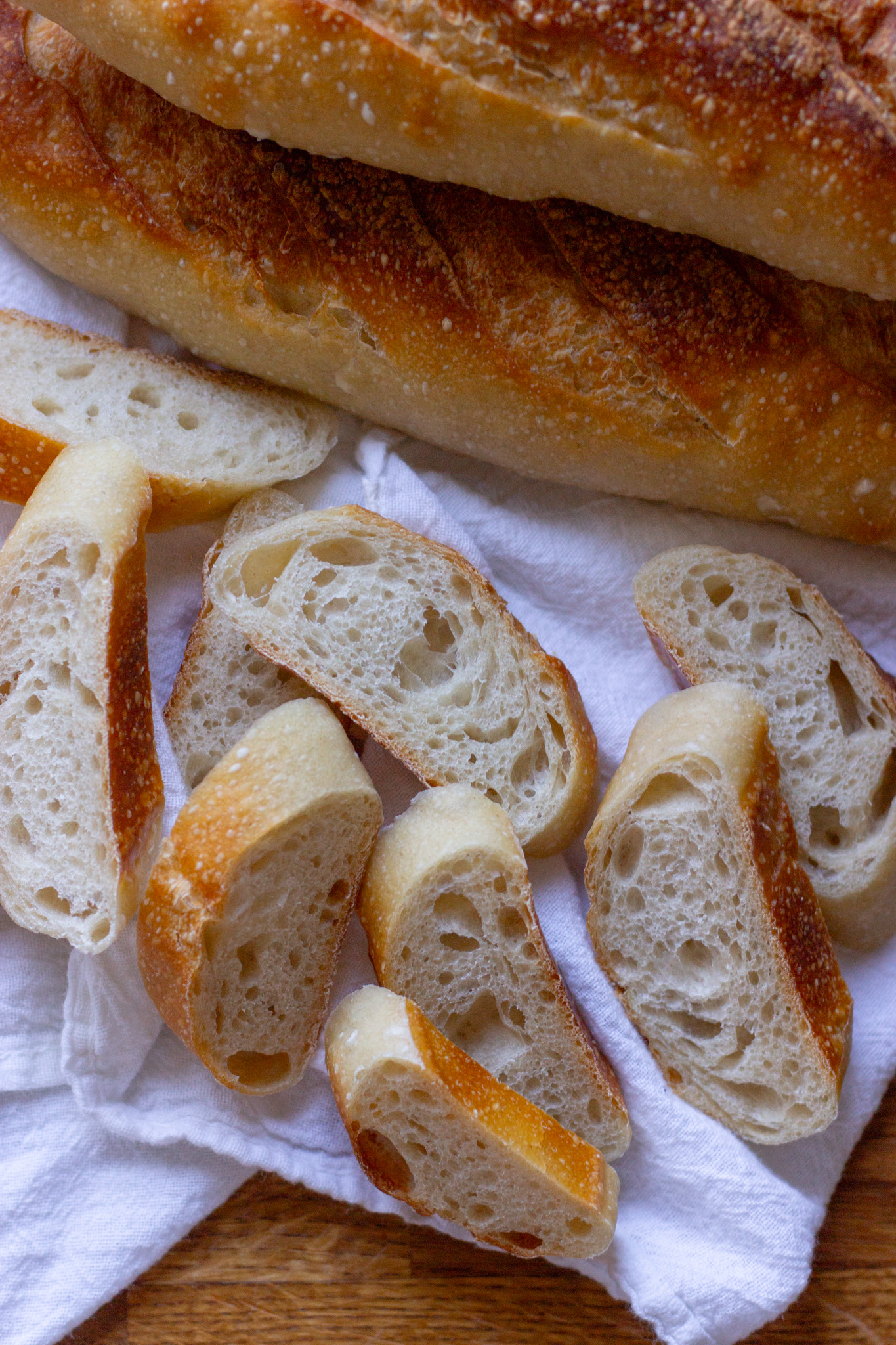
Really good sourdough baguette made in a home oven with no special tools or ingredients. The crust is thin and crisp, the interior is a perfect combination of chewy and fluffy, and there’s so much flavor from the slow rise. They're good on their own, made into a sandwich, dipped in herby oil, or sliced and slathered with jam or salty European butter.
Good baguettes are infamously hard to make in a home oven. This recipe gets around that by creating a sort of "Dutch oven" by inverting a baking sheet over the baguettes as they bake. (It's the same idea as baking sourdough in loaf pans instead of a Dutch oven.)
Quick Look: Sourdough Baguette
- Recipe Name: Sourdough Baguette
- Ready In: 8 hours - 2 days
- Serves: About 8, depending on what you're using them for - this recipe makes 4 (roughly 10-inch long) baguettes.
- Calories: 228 calories per serving.
- Main Ingredients: All purpose flour, water, active sourdough starter, salt.
- Why You'll Love It: Baguettes that are fluffy and chewy on the inside, with a thin, crispy crust. These are so easy to make at home in a regular oven, and require no special ingredients or equipment!
SUMMARIZE & SAVE THIS CONTENT ON
I studied abroad in France, so I think you should know that baguettes are basically my culinary Mt. Everest.
This is a recipe I’ve been working on for years. (You can see an earlier attempt of it in this post of epic fails from 2025) I’ve tried all different flour combinations, shaping methods, baking times and temperatures, and by some miracle, this is one of the simplest recipes on this entire site!
Two tricks that make these so easy
- Shaping - There is a very specific way that baguettes are traditionally shaped. I’ve tried this method dozens of times and not had success with it - it lead to oddly shaped loaves and lots of gapping. So I’m leaving the official method to the pros, and us home bakers can do this easy, fool-proof method of dividing the dough into fourths and rolling it up (see below for visuals!)
- Baking - It's hard to get baguette crust right in a home oven. These baguettes bake on a regular metal sheet pan, and for the first portion of baking, they have a second sheet pan on top of them to create the perfect amount of steam. This will allow the baguettes to expand as needed while baking, and prevent the crust from getting too thick. For the last portion of baking, the top sheet pan is removed to allow the crust to crisp up and brown.
Jump to:
- Quick Look: Sourdough Baguette
- Two tricks that make these so easy
- Why You’ll Love This Recipe
- Key Ingredients
- Easy Substitutions + Variations
- How To Make Sourdough Baguettes
- VIDEO: The easy way to shape baguettes!
- Expert Tips
- Sourdough Baguette FAQ’s
- Storage and Reheating
- More Sourdough Recipes From Around The World You’ll Love
- Sourdough Baguette
Why You’ll Love This Recipe
- It's so simple - I've been workshopping this recipe for YEARS and am happy to report that it's gotten simpler and simpler as it's been fine tuned. The dough and the method are all very straightforward.
- No special ingredients - This calls for regular all purpose flour. If you feel like using bread flour, you can totally do that, but there's no need to make a special trip to the store for some if you don't already have it!
- No special tools - There are all sorts of specialty items you can buy for making baguettes, and this recipe requires none of them. Just a couple of metal sheet pans and a regular oven and you're ready to bake!
- REALLY good baguette - I consider myself somewhat of a baguette snob, and these pass all my tests with flying colors. They've got a thin but crisp crust, and a light interior that's fluffy and chewy at the same time.
- A flexible schedule - You can do the second rise on the counter for same-day baguettes, or do it in the fridge for baguettes later.
- A low hydration dough - It's 64% hydration to be precise. This means it's so easy to handle, but with proper fermentation will still give you airy loaves!
Key Ingredients
As you can see, this is a really basic bread recipe. If you can make a regular loaf of sourdough, these will be a breeze!
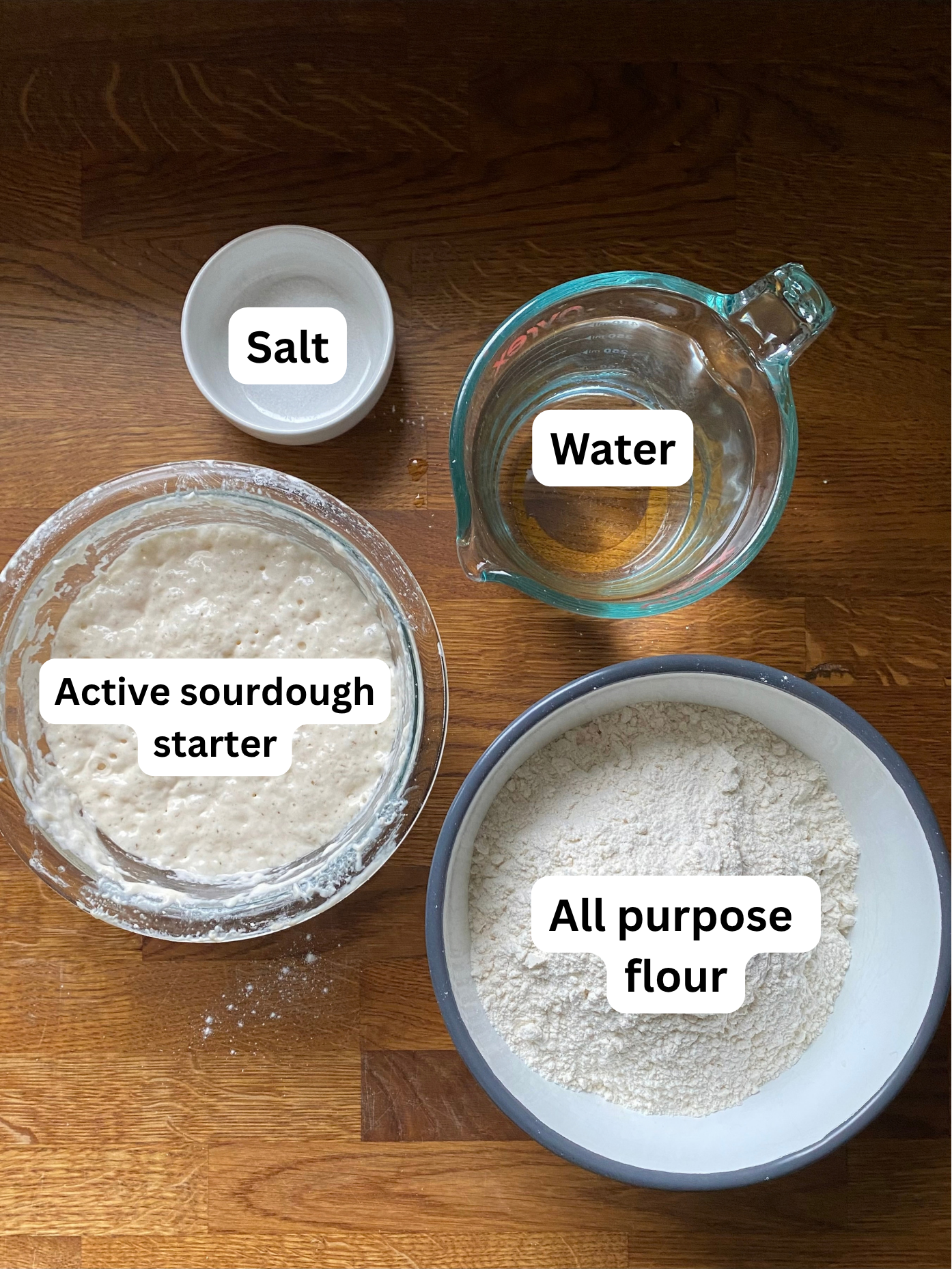
The flour - I typically use all purpose flour for this, but you can use bread flour for a slightly chewier result.
Easy Substitutions + Variations
- Use bread flour instead of all purpose if you want slightly chewier loaves. This is the only flour substitution I can vouch for here!
- If you want more of a white dusted look to your baguettes, you can dust them with rice flour before scoring.
How To Make Sourdough Baguettes

VIDEO: The easy way to shape baguettes!
Expert Tips
- Use wet hands for the stretch and folds to prevent dough from sticking to you.
- As always with sourdough recipes, go by the dough and not by the clock for rise times. The times included in the recipe are what it typically takes in my kitchen. It could be different for you!
- If you want a lighter crust, shorten the bake time after the second sheet pan comes off.
- Modifying the sour flavor - Since this uses so much starter, the sour flavor is very understated. I find this makes it a crowd pleasing baguette, but feel free to do the second rise in the fridge to make it more sour.
- Baguettes have famously tapered edges, but be careful not to make the them too pointy as they can dry out in the oven.
Sourdough Baguette FAQ’s
Traditionally, baguette dough has a higher hydration level than regular bread dough. This recipe uses a lower hydration dough, which makes it very easy to work with, but still delivers really good baguette.
The most authentic flour for making French baguettes is French flour that's high in ash. But! Before you go trying to source that, I'm going to let you in on a secret: if you're not in France, you're not going to be able to make French baguette. The flour is different. The humidity is different. The water is different. The yeast in the air is different! What you CAN do though, is make really good baguettes wherever you are in the world. And for that, you can use regular old all purpose flour (especially with this low-hydration dough!)
There are a lot of benefits to using sourdough in baguettes! Did you know that there are actual French laws regulating both the ingredients and methods for making real French baguettes? They can only contain four ingredients (flour/water/salt/yeast OR sourdough starter), and must undergo a slow rise. Sourdough lends itself perfectly to the slow rise, giving you baguettes with lots of flavor.
Storage and Reheating
- Storage - Once they're completely cooled, these can be stored in a bread bag at room temperature for up to 5 days. They're freshest on the day they're baked, but you can easily reheat to freshen them up (instructions below).
- Reheating - Quickly run your baguette under a running faucet to moisten the crust. Bake directly on the rack of a 375 degree oven for 8-10 minutes, until heated through and the crust has re-crisped. (Running it under water may feel counterintuitive, but it ensures the crust reheats to be soft AND crisp.
- Freezing - Baguettes can be wrapped very well and frozen for up to 3 months. Thaw at room temperature and follow the reheating instructions above.
More Sourdough Recipes From Around The World You’ll Love


did you make this recipe?
I would love to hear how it went! Please leave a comment and review down below.

Sourdough Baguette
Ingredients
- 250 grams water
- 200 grams sourdough starter
- 450 grams all purpose flour
- 12 grams salt
Directions
- Combine the water and starter in a medium bowl. Add the flour and salt and mix until well combined. You will need to mix with your hands for a few minutes to ensure it’s fully mixed. Cover well.Over the next 2-3 hours, perform 3 rounds of stretch and folds. Then, let the dough rise for an additional 2-3 hours, until puffed up.Line a baking sheet with parchment paper.Turn dough out onto a floured surface. Press out into a disc, popping any large bubbles that have formed, and use a bench scraper to divide into 4 triangles. Take one triangle at a time and shape into a long loaf, rolling from the inside point of the triangle out to the long, rounded end. Pull against your work surface to tighten as you roll, and after it’s shaped. Pinch the edges to seal and to make them come to a point for a classic baguette look. Place seam side-down on the prepared baking sheet. Repeat with the remaining pieces of dough. Cover well and let rise 2-3 hours, until puffed up. (You can alternatively do this rise in the fridge - see notes for details.)When ready to bake, preheat the oven to 450 degrees. Score 3 diagonal lines down each baguette. Place a second baking sheet upside down over the baguettes to create a closed baking vessel. (This will give them the steam they need as they bake). Bake in the top third of the oven for 30 minutes. Remove the top baking sheet and continue baking 5-10 minutes more. If you want a darker crust, bake directly on the oven rack for the last few minutes of baking.Cool at least 20 minutes before slicing.
Notes
- Storage - Once they're completely cooled, these can be stored in a bread bag at room temperature for up to 5 days. They're freshest on the day they're baked, but you can easily reheat to freshen them up (instructions below).
- Reheating - Quickly run your baguette under a running faucet to moisten the crust. Bake directly on the rack of a 375 degree oven for 8-10 minutes, until heated through and the crust has re-crisped. (Running it under water may feel counterintuitive, but it ensures the crust reheats to be soft AND crisp.
- Freezing - Baguettes can be wrapped very well and frozen for up to 3 months. Thaw at room temperature and follow the reheating instructions above.


Leave a Reply